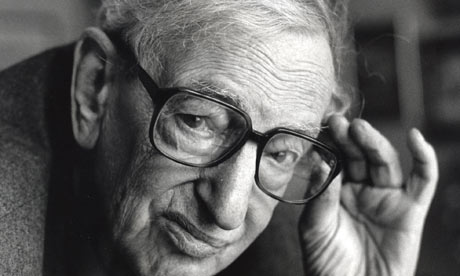
Adolf Burger was in London recently to publicise the English edition of his memoir:
The Devil's Workshop (published by Frontline Books). Burger is a Slovakian Jew, who survived Auschwitz before being transferred to Sachsenhausen concentration camp near Berlin in 1944. There, he was involved in Operation Bernhard - the top secret Nazi plan to forge millions of pounds worth of sterling and US dollars.
Now 91-years old, Burger is one of the very few survivors of the forgery operation, and - as a former inmate of Auschwitz-Birkenau - is also an eyewitness to the Holocaust.
In Roger Moorhouse's interview - which is transcribed below - the historian begins by asking Mr Burger his reasons for writing the book:
Interview with Adolf Burger
RM Mr Burger, you have come to London for the publication of the English edition of your memoir – The Devil’s Workshop. What was you reason for writing the book?AB I have written quite a few books; the first one appeared in August 1945 in Prague, it was very thin, with only six photos that I had taken myself after the liberation in Ebensee. Then, later, I was working as a journalist and had collected over 200 documents and photos on this subject from across Europe, so I decided to write this book. When one reads a book, I think one must also see the images and documents from the time. Otherwise, if one reads, and one doesn’t see the pictures and documents then one does not believe that it is true.
RM So was the book written, in some way, as proof of your story?AB No. I don’t have to prove anything. I wanted to show people what the Nazis were cap
able of, and what the [Slovak fascist] Hlinka Guard was cap
able of. That’s what I wanted to do, and that’s what I have achieved.
RM You were arrested and sent to Auschwitz in May 1942. Can you briefly describe how you came to Auschwitz, what you did there and what the conditions were like?AB I was arrested because I was printing forged baptismal certificates for Slovak Jews. The Gestapo then arrested me, and my wife, and we were first sent to Zilina, where
about 1,000 Jews were held. Then we were put into a train by the Hlinka Guard and were taken to the Ge
rman border, where we were handed over to the SS. We ended our journey at Auschwitz.
RM And you had no idea, no suspicion, of what might happen to you there?AB No, of course not. No-one knew. They didn’t even know
about it in Switzerland. My brother in Israel managed to get them to send me a certificate granting me emigration to Israel, and the Swiss sent it to Birkenau! So the organisation in Switzerland didn’t even know what Auschwitz and Birkenau was. No-one did.
RM How was it then that you came to leave Birkenau?AB Birkenau was hell. I worked on the ramp there, and had seen every day how 3,000 people would arrive by train and would disappear into the gas chambers.
But one day at roll call, they called out six names – all typographers. They had a card index of the prisoners and so they knew what we had done before arriving in the camp. So, then I had to go and see the camp commandant, an SS-Stu
rmbannführer. He confi
rmed my name and that I had been a typographer, and then told me that I would travel to Berlin as a free man and work in a library. All lies. So, the next day, they called the six names again, six printers, and we were put into quarantine for four weeks as they were so afraid of typhus. After that, six SS officers came down from Berlin, from the Sicherheitsdienst, and they accompanied us to the train – but it was not a freight car, it was a passenger train – and they took us to Berlin and then to Sachsenhausen.
RM So, from your time in Auschwitz-Birkenau, you knew full-well what was going on there. And then you were sent to Sachsenhausen. Was that not some sort of miracle for you?AB No. I didn’t see it as a miracle at all. People were moved around the camps – transferred here and there all the time. And I didn’t believe them anyway – they said I would go as a free man, and would work in Berlin in a library; it was all lies. I arrived in Sachsenhausen and was put into blocks 18 and 19 [the forgery workshops] – all separated off with barbed wire, windows whitewashed, top secret, no-one knew what went on in there. The other 100,000 prisoners in Sachsenhausen were not allowed to even set eyes on us. When we went to the shower block on Sundays, for example, the whole camp was shut down – strict curfew, everybody confined to barracks – no prisoners, no SS-men, nobody was allowed to see us. And if anyone did see us they would be shot.
RM S
o, your two blocks were completely isolated within the camp, but did you nonetheless hear about what was going on elsewhere – outside in the camp itself, or the general progress of the war?AB We had a radio in our two blocks, so we listened to the radio in the evening – the news, reports from the front and so on – but we were completely cut off from the camp, we did not even see the faces of the other prisoners, so we heard nothing from them.
RM What were conditions like for you in the camp?I printed £132 million!
AB I always said I was a dead man on holiday – a dead man on holiday. We never believed that we would get out of there. But in the block we had everything – food, white sheets on the beds – each one of us had his own bed; not like in Birkenau, where six of us slept under a single louse-ridden blanket. Also, the SS guards never shouted at us, I used to play t
able-tennis with them.
But we knew that we were dead men on holiday. We knew that there was no way out when we knew a secret such as this – that the Nazis were printing millions in forgeries – and we were sealed away inside a concentration camp, where no-one could see us. We knew that we would not get out alive.
RM And what was your role within the forgery operation?AB I was a printer, and I printed £132 million!
RM And what did you think about your work there?AB I didn’t think. I was in a concentration camp and I was ordered to do it. Print the money, so I printed it. If I hadn’t done it they would have shot me. We had no “feelings”, we didn’t think
about it.
RM In the film that is based on your memoir, The Counterfeiters, there are a number of scenes where there is conflict between the prisoners about the morality of forging money for the Nazis. What was the reality?AB It’s just a film. There were no discussions of morality. We were in a concentration camp – we were scarcely in a position to s
abotage anything. Sure you could s
abotage, if you wanted to get killed! Jacobson [one of the prisoners] tried to delay the dollar production, but he managed for only 4 weeks, then [SS-Stu
rmbannführer] Kruger came and said ‘make the dollars within 3 weeks or we will have you shot’, and that was the end of it. Two weeks later, we had made the dollar. You have to understand that we were in a concentration camp – we had one foot already in the grave.
RM Can you describe some of the characters within the forger group – Smolianoff for example?AB Smolianoff was my best friend. He was a professional forger, the only professional forger in the group, by the way. He had already been imprisoned for four years for forging. And he wanted to prove to Kruger that we could do it.
RM Can you also describe SS-Sturmbann Kruger, who headed the operation?AB He was an SS officer. He wanted the job to be done, nothing else.
RM After the war, some of the forgers from your group testified for Kruger at his trial. How do you explain that?AB Some of them. The Ge
rman prisoners. The Ge
rman prisoners said that he was a good man. They didn’t invite me to the court. In the two trials in which I participated, the defendants got life. If they had asked me I would have told them that he was a murderer, that he had six people shot. Of course, he let us play cards and ta
ble tennis, but that was all only in his interest, so that the printing machines would run and that the job would be done.
RM You survived both Auschwitz-Birkenau and Sachsenhausen. Did you have a particular survival-strategy, or was it just pure chance?AB No. You could not have any sort of strategy in those places. It was impossible. What saved me was that I was needed as a typographer, and then that the Nazis decided to move everything – the machinery and the personnel – to Austria at the end of the war, where I was then liberated by the Americans, who arrived so quickly that the Nazis all ran away. The thing [that saved me] was that I was a printer. If I had not been a printer then I would never have got out of Auschwitz-Birkenau and I would not have survived.
RM What would you say – as a survivor of Auschwitz and Sachsenhausen – to those who still deny that the Holocaust took place?AB They are fascists. They are Nazis. Could be an Englishman, an American, whatever, but if they say that then they are Nazis. That ideology is a Nazi ideology.
RM When you think back on that terrible time, is there one particular memory, person or image that springs to mind first of all?AB No. Every day was the same. From the day that I was arrested, nothing was better or worse, it was always the same. Always the SS behind me, the ever-present threat of being shot, you had to work – that was my existence.
©
Roger Moorhouse 2009

 At the weekend, I visited the British Museum’s newly opened Paul and Jill Ruddock Gallery of Medieval Europe. Regular visitors to the BM won’t see anything new on display, but they will see a coherent and informative collection of medieval artefacts put together by curator James Robinson (whose Masterpieces of Medieval Art, published by the BM, is a superb commentary on the display). The Lewis Chessmen finally gain the prominence they deserve, but my own personal favourite from the gallery is the Dunstable Swan Jewel. This exquisite white enamelled livery badge dates from about 1400. The swan was associated with the House of Lancaster. It has a delicacy and fragile beauty that mirrors the National Gallery’s Wilton Diptych from the same period and reminds us that the Middle Ages were not all tenebrous gloom.