
Perhaps the sanest conrtibution to the great Hobsbawm debate came from Tristram Hunt in Saturday's Guardian. Hunt, whose article on Friedrich Engels is one of the highlights of our forthcoming May edition, states the bald truth that 'the reason Hobsbawm is worthy of respect is that he is one of our greatest historians', his works masterpieces of narrative history, insightful in analysis and of vast breadth.
Though I still feel uneasy about Hobsbawm's Soviet-supporting past, to condemn him as a historian is a little like dismissing Milton's poetry because one dislikes the author's religious views, or condemning Wagner's music because of its composer's bizarre beliefs. As for Hunt's assertion that his critics at the Mail should read his books; we all should. One cannot understand the long 19th century (Hobsbawm's own phrase) without doing so.
Showing posts with label Hobsbawm. Show all posts
Showing posts with label Hobsbawm. Show all posts
Monday, 16 March 2009

Tuesday, 10 March 2009
Eric Hobsbawm
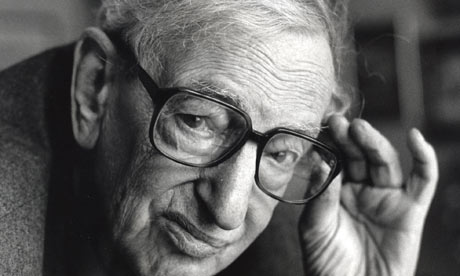 Eric Hobsbawm is the subject of much criticism in the light of his attempt to see his MI5 files. Michael Burleigh, Stephen Glover and Geoffrey Levy have offered caustic appraisals of 'Britain's Greatest Living Historian' in the Mail. Seumas Milne in the Guardian offers a robust defence of Hobsbawm's lifelong support for Soviet Communism.
 Unlike EP Thompson and many other British Marxists, Hobsbawm did not resign his membership of the Communist Party after the crushing of the Hungarian Uprising of 1956, nor did he do so after Soviet tanks rolled into the Czechoslovak capital to end the Prague Spring.
After all, as he points out, without a trace of irony, in his collection of essays On History (1997): ‘Fragile as the communist systems turned out to be, only a limited, even minimal, use of force was necessary to maintain them from 1957 until 1989’.
‘Fragile as the communist systems turned out to be, only a limited, even minimal, use of force was necessary to maintain them from 1957 until 1989’.
Hobsbawm stayed with the party until it simply withered away. Curiously, he went on to accept the offer of a Companion of Honour made by Tony Blair. The honour has been awarded to just 45 living individuals, whose motto is In Action Faithful and in Honour Clear. It does seem an anomaly. But I think Hobsbawm's ambiguities can be explained.
He is, like many intellectuals of the European tradition - and anyone who has read his autobiography will appreciate that he identifies totally with the European tradition, displaying an evident loathing towards the USA and a studied indifference to Britain - immersed in abstraction. Hobsbawm has lived the privileged life of a gifted intellectual for whom real life barely exists at all, hence his strange indifference to the suffering of people under the Soviet regimes.
That Hobsbawm is a brilliant historian is evident to anyone who had read his great trilogy on the long 19th century (a judgement echoed by such disparate figures as Niall Ferguson and Tristram Hunt). But he doesn't do people. He is unashamedly a ‘Tory Communist’, above and beyond the concerns of ordinary folk. As such, that he can be an unrepentant marxist and accept a companion of honour should come as no surprise at all.
Britain's Greatest Living Historian?
Eric Hobsbawm is often declared 'Britain's Greatest Living Historian', but is that really the case? Are there others more worthy of that title? What about Peter Burke, Christopher Bayly, Chris Wickham, Judith Herrin or Robert Bartlett among many, many others? Or do only modernists count?
Subscribe to:
Posts (Atom)